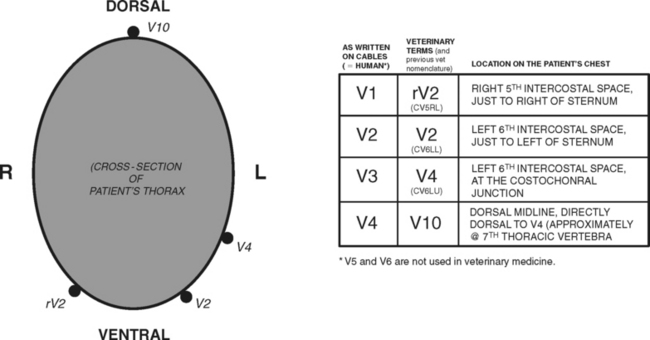
E
Echocardiography
INDICATIONS
EQUIPMENT, ANESTHESIA
PREPARATION: IMPORTANT CHECKPOINTS
POSSIBLE COMPLICATIONS AND COMMON ERRORS TO AVOID
PROCEDURE
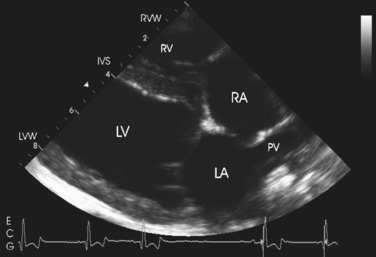
ECHOCARDIOGRAPHY Right parasternal four-chamber long-axis view in a normal dog (obtained without shaving). IVS, Interventricular septum; LA, left atrium; LV, left ventricle; LVW, left ventricular wall; PV, pulmonary vein; RA, right atrium; RV, right ventricle; RVW, right ventricular wall.
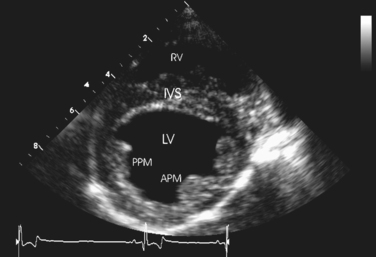
ECHOCARDIOGRAPHY Right parasternal short-axis view at the left ventricular papillary muscle level in same dog. From this view, gentle pivoting motion (caudal/ventral to cranial/dorsal) of the transducer beam toward the base will reveal the other four standard views obtained from this location. APM, anterior papillary muscle; IVS, interventricular septum; LV, left ventricle; PPM, posterior papillary muscle; RV, right ventricle.
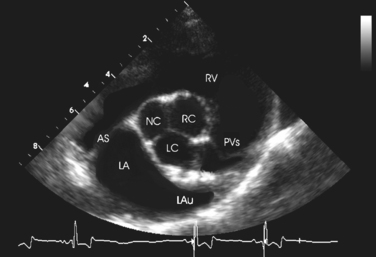
ECHOCARDIOGRAPHY Remaining in the same right parasternal window as the two previous views, gently pivoting toward the heart base, the right parasternal short-axis view at the left atrium/aorta level was obtained in the same dog. AS, atrial septum; LA, left atrium; LAu, left auricle; LC, left coronary cusp; NC, noncoronary cusp; PV, pulmonary vein; PVs, pulmonic valve; RC, right coronary cusp; RV, right ventricle.
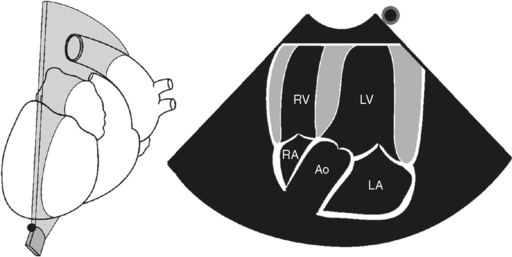
ECHOCARDIOGRAPHY Five-chamber view is obtained at left apical parasternal location. Left apical parasternal location is the only time during echocardiographic examination when index mark on head of transducer is directed caudally. Ao, aorta; LA, left atrium; LV, left ventricle; RA, right atrium; RV, right ventricle.
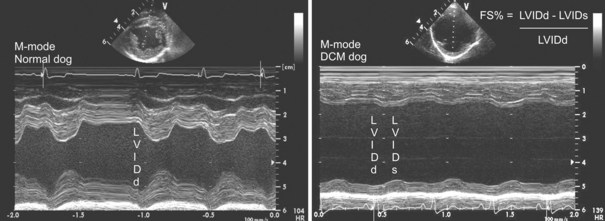
ECHOCARDIOGRAPHY Two M-mode studies of left ventricle. Left, Normal dog shows vigorous excursions of the interventricular septum (above) and left ventricular free wall (below) from systole to diastole. The absolute diameter of the left ventricle is within normal limits. Right, Dog with dilated cardiomyopathy has visibly poor left ventricular systolic function (almost no difference between systole and diastole) and a very enlarged left ventricular diameter compared to normal.Bonagura JD. Echocardiography. J Am Vet Med Assoc. 1994;204:516-522.
Oyama MA. Advances in echocardiography. Vet Clin North Am Small Anim Pract. 2001;34(5):1083-1104.
Thomas WP, Gaber CE, Jacobs GJ, et al. Recommendations for standards in transthoracic two-dimensional echocardiography in the dog and cat. J Vet Intern Med. 1993;7:247-252.
Electrocardiography
EQUIPMENT, ANESTHESIA
POSSIBLE COMPLICATIONS AND COMMON ERRORS TO AVOID
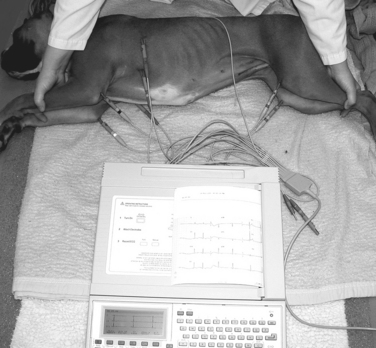
ELECTROCARDIOGRAPHY Patient is comfortably restrained in right lateral recumbency, with proximal long bones of the limbs perpendicular to long axis of body. Insulating (waterproof, foam core) pad and fleece blankets are under patient to reduce the influence of electrical interference.ECG Clip/Electrode Placement for Standard Limb Leads (I, II, III, aVR, aVL, aVF)
| RA, white | Right forelimb; clip to skin just proximal to the olecranon (caudal triceps region). |
| LA, black | Left forelimb; clip to skin just proximal to the olecranon (caudal triceps region). |
| RL, green | Right hind limb; clip to skin just proximal to the stifle (cranial thigh); ground wire. |
| LL, red | Left hind limb; clip to skin just proximal to the stifle (cranial thigh). |
PROCEDURE
POSTPROCEDURE
The clips are carefully detached from the skin prior to releasing the animal’s restraint.
ALTERNATIVES AND THEIR RELATIVE MERITS
Electromyography (EMG) and Motor Nerve Conduction Velocity (NCV)
OVERVIEW AND GOALS
INDICATIONS
EQUIPMENT, ANESTHESIA
PREPARATION: IMPORTANT CHECKPOINTS
PROCEDURE
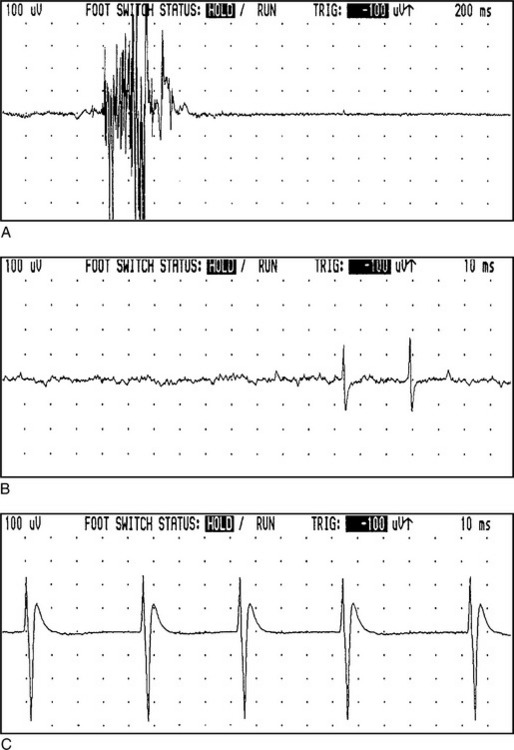
ELECTROMYOGRAPHY (EMG) AND MOTOR NERVE CONDUCTION VELOCITY (NCV) Types of electrical activity seen in normal muscle during electromyography evaluation. A, Insertional activity. Note abrupt onset and termination of activity associated with needle placement (100 mV/div; 200 msec/div). B, Miniature end-plate potentials with two end-plate spikes indicating close proximity of needle to an end plate (100 mV/div; 10 msec/div). C, Motor unit action potentials seen during voluntary muscle activity in an awake animal (100 mV/div; 10 msec/div).(Reprinted with permission from Cuddon PA: Electrophysiology in neuromuscular disease, Vet Clin North Am Small Anim Pract 32:31-62, 2002.)
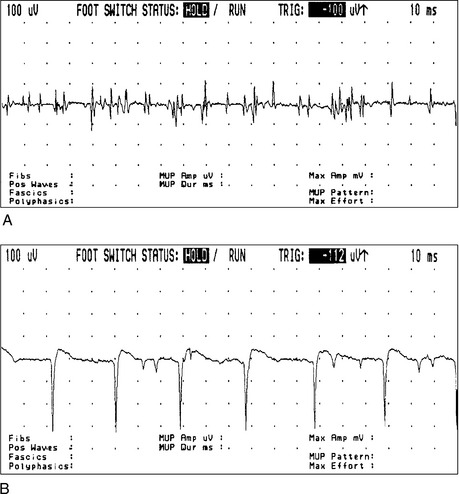
ELECTROMYOGRAPHY (EMG) AND MOTOR NERVE CONDUCTION VELOCITY (NCV) Electromyography: abnormal spontaneous electrical activity. A, Fibrillation potentials, moderate density (100 mV/div, 10 msec/div). Fibrillation potentials may be associated either with denervation secondary to axonopathy or with primary myopathy. Density and consistency of observed fibrillation potentials are accurate reflections of severity of muscle involvement. B, Spontaneous electrical activity in the form of positive sharp waves (100 mV/div; 10 msec/div).(Reprinted with permission from Cuddon PA: Electrophysiology in neuromuscular disease, Vet Clin North Am Small Anim Pract 32:31-62, 2002.)
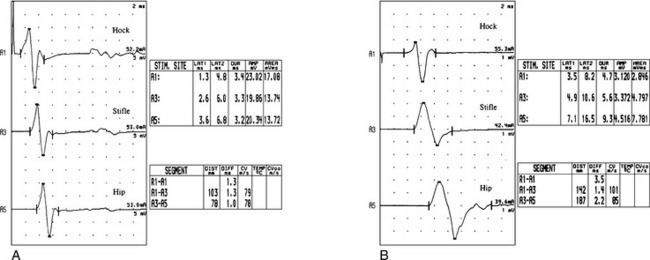
ELECTROMYOGRAPHY (EMG) AND MOTOR NERVE CONDUCTION VELOCITY (NCV) Motor nerve conduction studies recorded from the plantar interosseous muscles following stimulation of the sciatic-tibial nerve at the hock, stifle, and hip in a normal dog (A) and in a dog with generalized muscle disease (B) (mitochondrial myopathy). Note marked generalized decrease in compound muscle action potential (CMAP) amplitudes (3.12, 3.37, and 4.51 mV) from all sites of stimulation in the myopathic dog when compared with the normal dog (23.02, 19.86, and 20.34 mV). Despite CMAP amplitude reduction, the dog with myopathy has normal MNCVs (101 and 85 m/sec). Generalized CMAP amplitude decrease can also be observed in prejunctional neuromuscular diseases such as botulism, as well as in primary axonopathies. (Recording parameters: A, 5 mV/div and 2 msec/div; B, 1 mV/div and 2 msec/div.)(Reprinted with permission from Cuddon PA: Electrophysiology in neuromuscular disease, Vet Clin North Am Small Anim Pract 32:31-62, 2002.)